DavidMendoza
I build products, systems, and businesses that solve real-world problems.
Over the past decade, I've worked across customer support, IT operations, quality engineering, software development, product ownership, and entrepreneurship — most recently building enterprise SaaS used by 500+ companies.

Core Belief
Technology should serve a purpose.
Not every problem needs artificial intelligence. Not every inefficiency requires a complex system. The best solutions often come from deeply understanding a workflow, identifying friction points, and applying the right combination of process improvement, automation, and technology.
AI should be used as leverage, not as a must-have just because it is trendy. Many problems can be solved with traditional automation, integrations, or better processes. AI becomes valuable when it helps people make better decisions, process information faster, or scale expertise across teams.
My Approach
- 1Understand the problem.
- 2Map the workflow.
- 3Identify inefficiencies.
- 4Build the right solution.
- 5Automate what can be automated reliably.
- 6Apply AI only where it creates measurable value.
- 7Measure outcomes and continuously improve.
Background
My Journey
Not just a developer. Not just an AI person. Someone who understands problems first, then builds the product, improves the process, automates the workflow, or creates the system that actually solves it.
The path from customer support to QA to software engineering to entrepreneurship gave me a perspective most engineers don't have: I've been on both ends of broken workflows, and I know the difference between a tool that looks good and one that actually gets used.
Customer & Technical Support
Started in customer support and technical support, learning the importance of communication, reliability, and customer experience. It became the foundation of everything I build.
IT Operations & Quality Engineering
Moved into IT operations and QA. When I joined a growing QA team, many internal processes were still being established. I worked closely with PMs, Engineers, and leadership to define testing workflows, quality standards, and documentation practices that became part of the SDLC.
Software Engineering & Entrepreneurship
Expanded into software engineering, product development, automation, AI-assisted workflows, and entrepreneurship. Launched products across desktop, mobile, web, and e-commerce, building full businesses, not just features.
Product Ownership at Blackthorn
Blackthorn was losing enterprise deals because its event pages could not be made on-brand. I created the Page Designer end to end to close that gap: problem discovery, architecture, code, and go-to-market. After the MVP, led the team that polished and hardened it through GA. It now serves 500+ enterprise customers.
Interim Product Owner
Stepped in as Interim Product Owner for a next-generation capacity management solution built to prevent ticket overselling. Aligned priorities across two cross-functional teams, partnered with Engineering Managers on trade-offs, and ran sprint planning as the bridge between Product and Engineering.
What I Do
Areas of Expertise
A decade of cross-functional experience compressed into the skills that matter.
Product Development
- Building products from concept to launch
- MVP development
- User experience
- Product ownership
- Product operations
Software Engineering
- Web applications & APIs
- Mobile applications
- Desktop applications
- WordPress plugins
- SaaS-style platforms
- CI/CD workflows
Automation & Process
- Workflow automation
- Business process improvement
- Operational systems
- Internal tooling
- Customer onboarding automation
Artificial Intelligence
- AI assistants & prompt engineering
- AI-powered recommendations
- Ticket analysis & triage
- Decision-support systems
- AI used only where it creates leverage
Quality Engineering
- QA process design
- Testing workflows
- Automation foundation
- Defect analysis
- Cross-functional collaboration
- Outcome validation
Entrepreneurship
- Launching products
- Managing customers
- Building platforms
- Monetization
- Product operations
- Scaling small businesses
Case Studies
Problems solved. Impact measured.
Every project started with a workflow that was not working. Here is how each problem was diagnosed, what was built, and what changed as a result.
Blackthorn Page Designer: Unblocking Enterprise Deals
Explore the onboarding experience ↗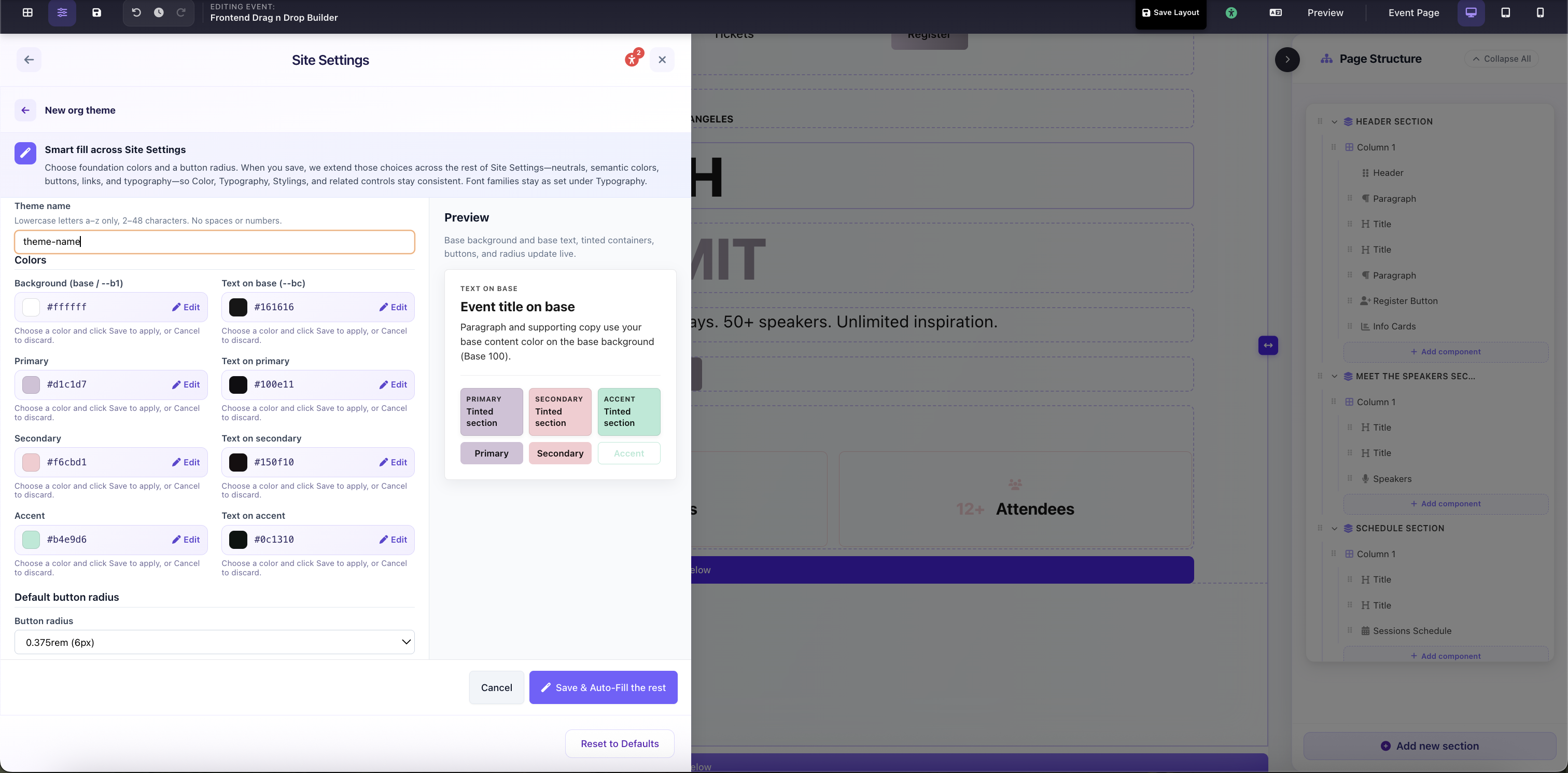
The Problem
Blackthorn was a strong events management platform, but its event landing pages carried an architectural limitation: customers could not make them look and feel like their own brand. For enterprise buyers, a branded event page is not a nice-to-have, it is a requirement. Deals were being lost at evaluation over it. The gap was not a missing feature on a roadmap, it was revenue walking out the door.
The Solution
Owned the product end to end: identified the problem, designed the architecture around the platform's existing constraints rather than against them, wrote the code, and helped shape the go-to-market. A modular drag-and-drop builder that reuses the production Angular event and registration components rather than reimplementing them, consumes live Salesforce event data, and integrates with the existing ticketing and checkout infrastructure. Enterprise customers get fully on-brand pages natively inside Blackthorn: component library, reusable templates, shared and event-specific layouts, theme tokens and full theming (fonts, gradients, semantic colors, custom CSS), device previews, translations, embedded checkout, and a built-in WCAG accessibility scan. Also built the shared design system and theme architecture that standardized styling across the reusable components. After the MVP shipped, led the team that hardened and polished it through to GA, and built an interactive onboarding product of 100 guided steps and 60+ annotated screenshots so customers could self-serve from day one. In a 17-respondent beta, 82% were satisfied with it and rated it better than the existing templates, with 59% calling it significantly better. It shipped and reached broad adoption ahead of the company's January 2026 platform-vision announcement, where it was presented as a delivered pillar alongside the forthcoming planner UI and AI layer.
In the Press
The modular, drag-and-drop page designer includes reusable components and flexible layouts so organizations can scale design consistency across events while maintaining creative control.
Create bold, on-brand event pages with drag-and-drop controls. No CSS. No dev work.
Also covered in: Business Travel News ↗
AI-Tomato: Autonomous Dev Workflow Platform
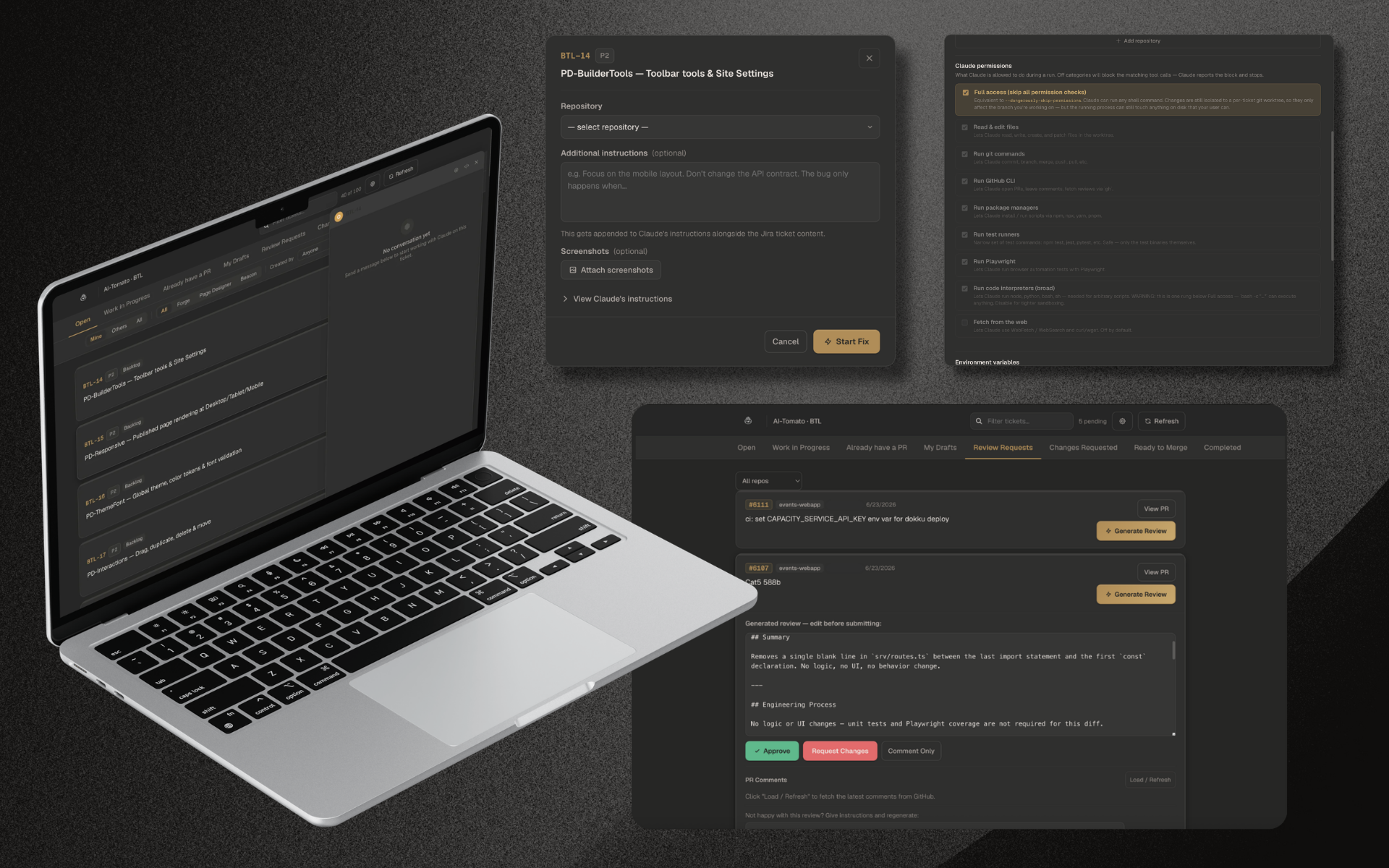
The Problem
Shipping a ticket meant the same manual chain every time: read the Jira issue, write the Gherkins, cut a branch, reproduce the problem, write tests, implement, capture before/after evidence, open a PR, then chase review and static-analysis feedback. Each handoff lost context, and the work of moving a ticket from assigned to merged was almost entirely undifferentiated. Engineering time went to the process, not the problem.
The Solution
A local dashboard that drives the entire ticket-to-merge workflow through Claude Code. Pick a ticket, hit Fix, and it opens an isolated git worktree, generates Gherkins, imports them to XRay, and drafts a technical plan, then stops for human approval. On approval it writes tests first, implements the fix, records before/after Playwright video, runs its own code review pass, opens a draft PR, and comments the solution back to Jira. Every prompt is a configurable skill rather than hardcoded text: 59 of them across 11 phases, composed into per-repo flows, with CI golden-file tests that fail any edit which silently changes what a phase sends. Multiple tickets run concurrently, each in its own worktree behind a dev-server lock.
CSS Customization AI for Non-Technical Users
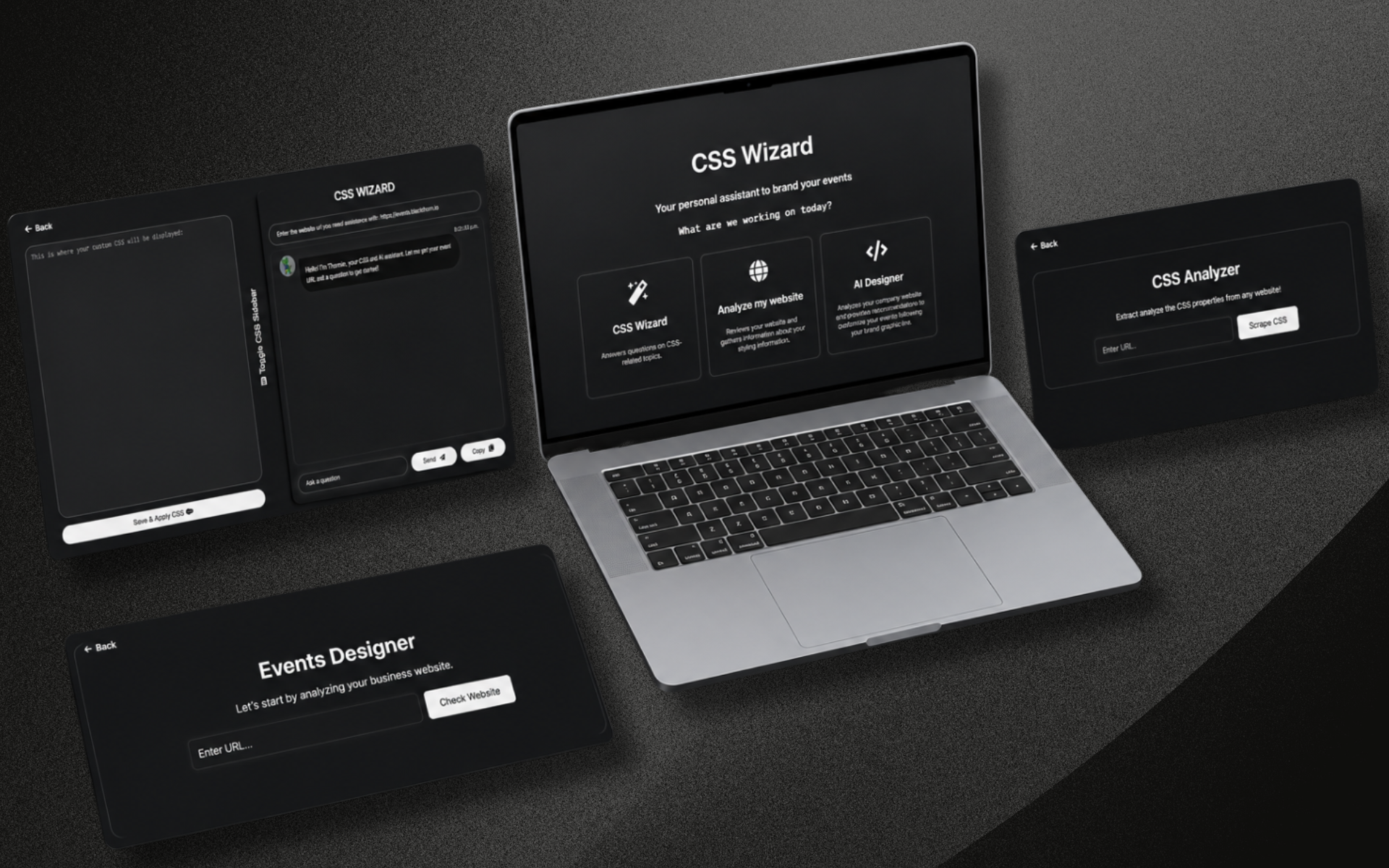
The Problem
Customers building event landing pages wanted to customize their layouts (change colors, resize elements, center content) but were not technical. Support agents in the customer service team were not trained in CSS either. Every question like "How do I change the button color?" became an engineering escalation, with days of wait time on both ends.
The Solution
Internal tool where support agents or customers paste their page URL and ask a plain-English customization question. Playwright scrapes the page structure to understand the layout, OpenAI analyzes it, and returns a specific CSS snippet they can copy-paste directly. No engineering required. Still in active use today.
Gabinci: Batch Mockup Generation for E-Commerce
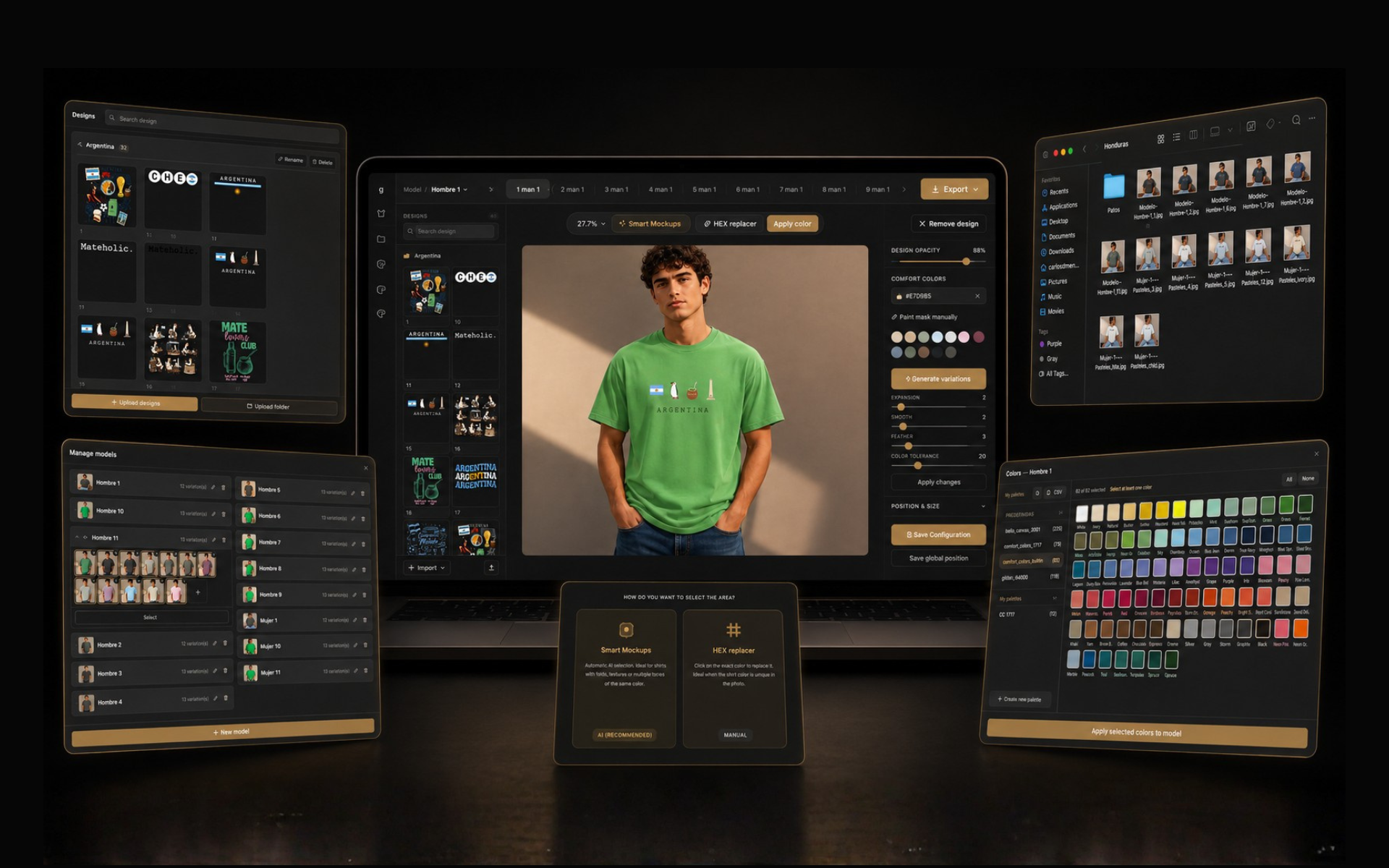
The Problem
E-commerce sellers creating product mockups had a 5-step manual process per design: place the model, define the crop area, paste the design, export, then run through an image optimizer. That was 10 to 12 minutes per design. A seller with one shirt in 20 color variations had to repeat it 20 times. That is over 3 hours for a single product line.
The Solution
Electron desktop app for Mac and Windows. Upload a model once. Using Facebook's SAM2 AI, running locally with no token cost, define the product area in one click. From there, export unlimited designs in all color variations in a single batch. Also built: a WordPress plugin for automated licensing and activation, and a GitHub Actions CI/CD pipeline that packages and publishes new releases automatically.
Sponsorship Automation Platform for Non-Profits
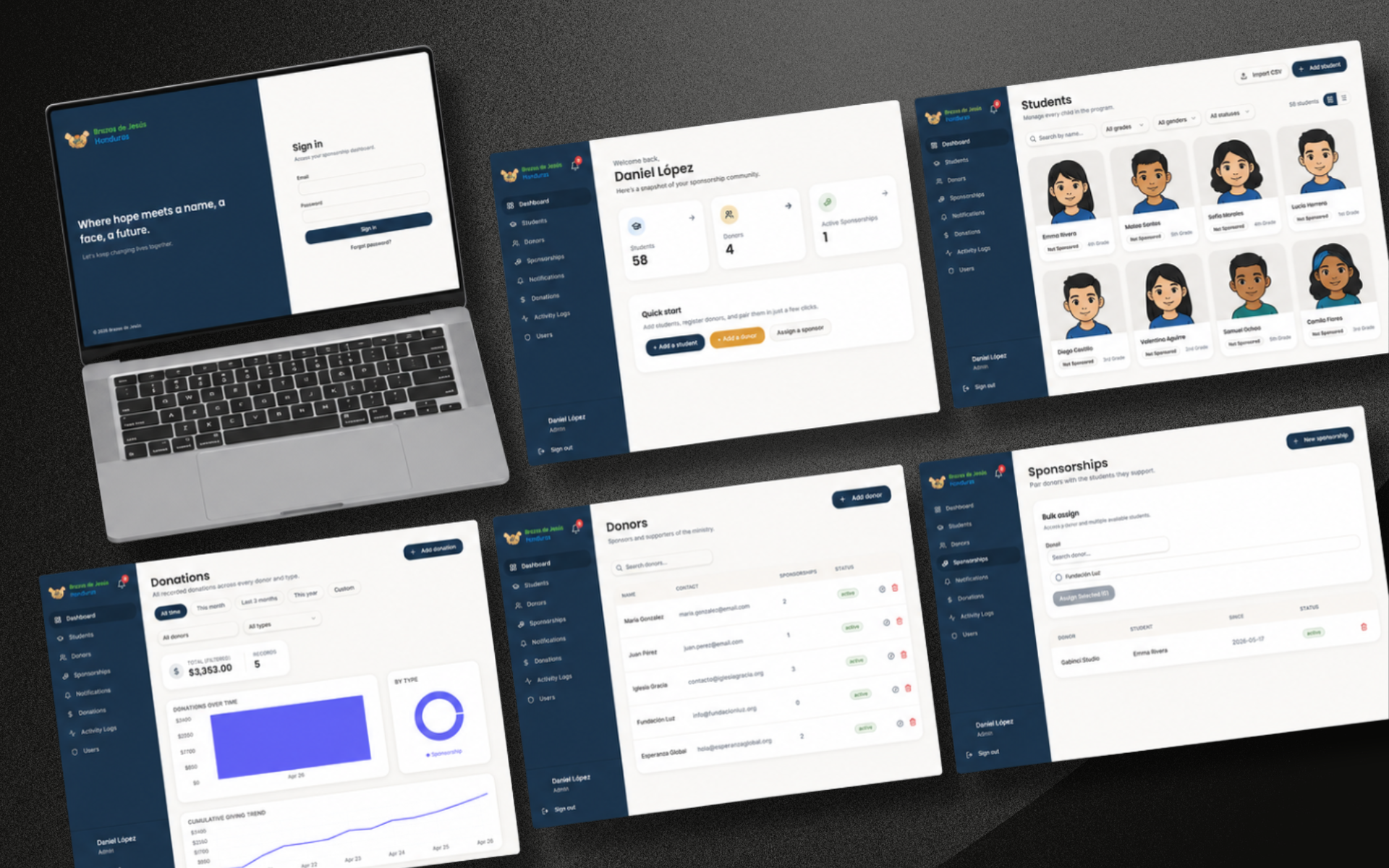
The Problem
A non-profit organization had no way to accept online donations. Donor relationships were tracked in spreadsheets. Email communications to donors were inconsistent and written manually. End-of-month impact reports (which needed to go to donors and the board) took several days to compile and send.
The Solution
Built a full website with integrated donation platform, an email communication workflow for donor relationship management, an organization activity tracker that pre-populates end-of-month donor update drafts, and a one-click report generator for board-level communications.
E-Dured: Learning Management System
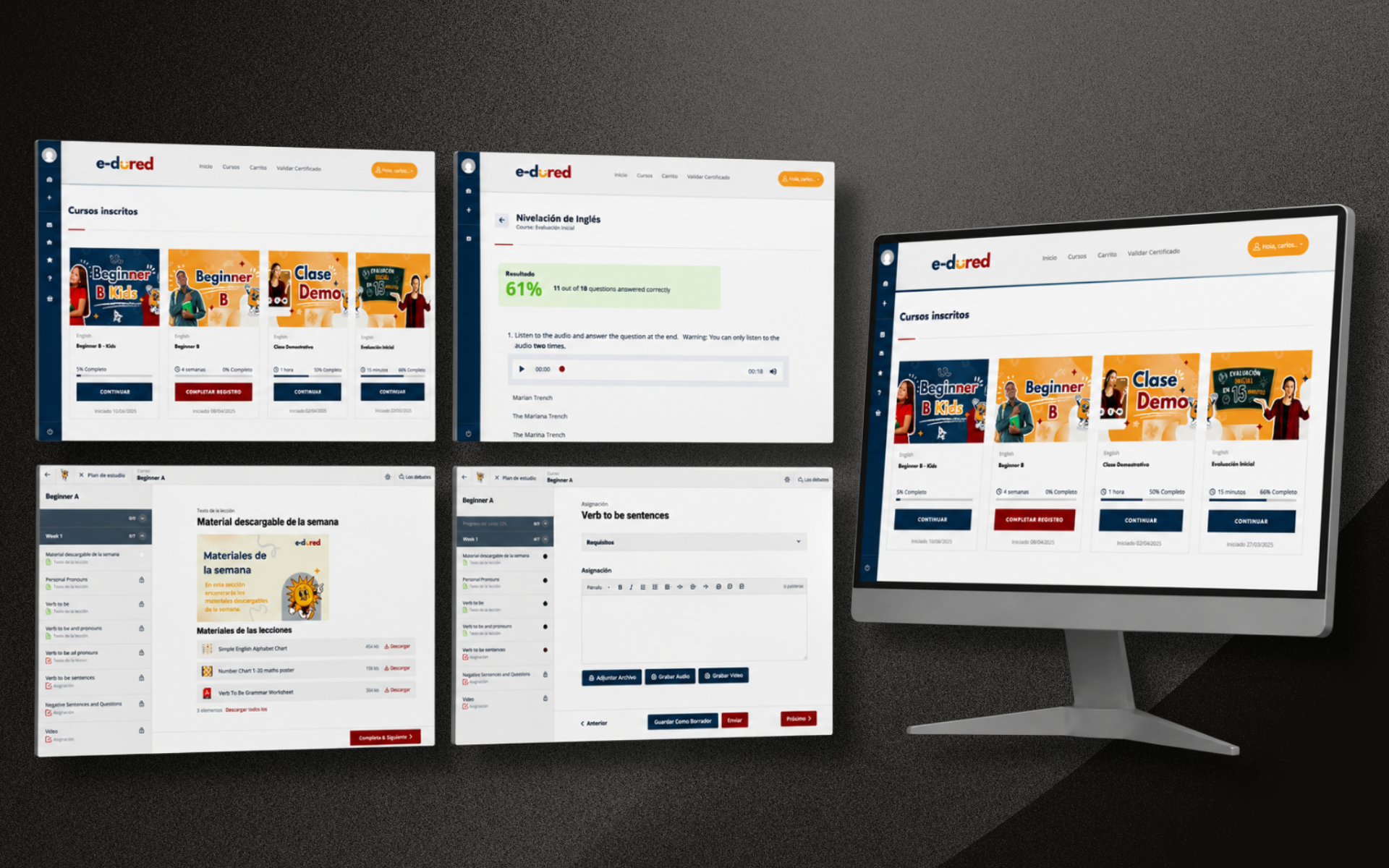
The Problem
A growing English education business managed students entirely through email and spreadsheets. Enrolling each student was a manual, multi-step process. There was no visibility into student progress or attendance. Scaling the business meant hiring more administrative staff instead of improving the product.
The Solution
Built a full LMS with self-serve enrollment, integrated payments, student progress tracking, instructor dashboards, and automated milestone communications. The entire student lifecycle, from first payment to course completion, runs without admin intervention.
Multi-Vendor Marketplace: Built During a Pandemic
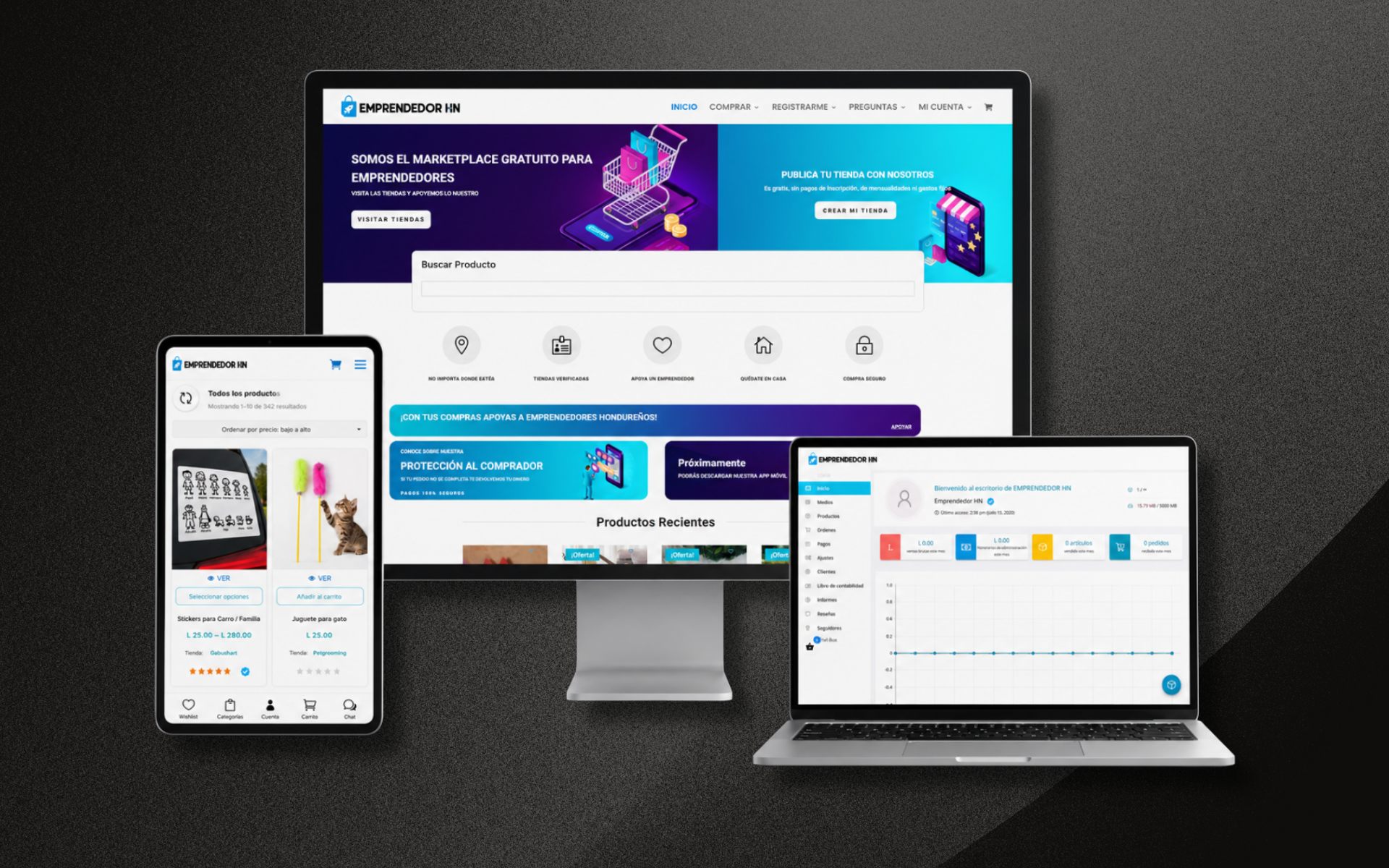
The Problem
In 2020, the pandemic shut down physical retail in Honduras overnight. Small business owners had no path to sell online. Existing platforms were inaccessible, too expensive, or did not support independent multi-vendor storefronts. The gap was real and immediate.
The Solution
Built, marketed, and operated a full multi-vendor e-commerce marketplace from scratch. Merchants could self-onboard, set up their own storefront, and start selling without calling anyone. Grew entirely through word of mouth, with zero paid advertising. Eventually wound down post-pandemic due to operating costs, but the model was fully validated.
MiPisto: Personal Finance App on Google Play
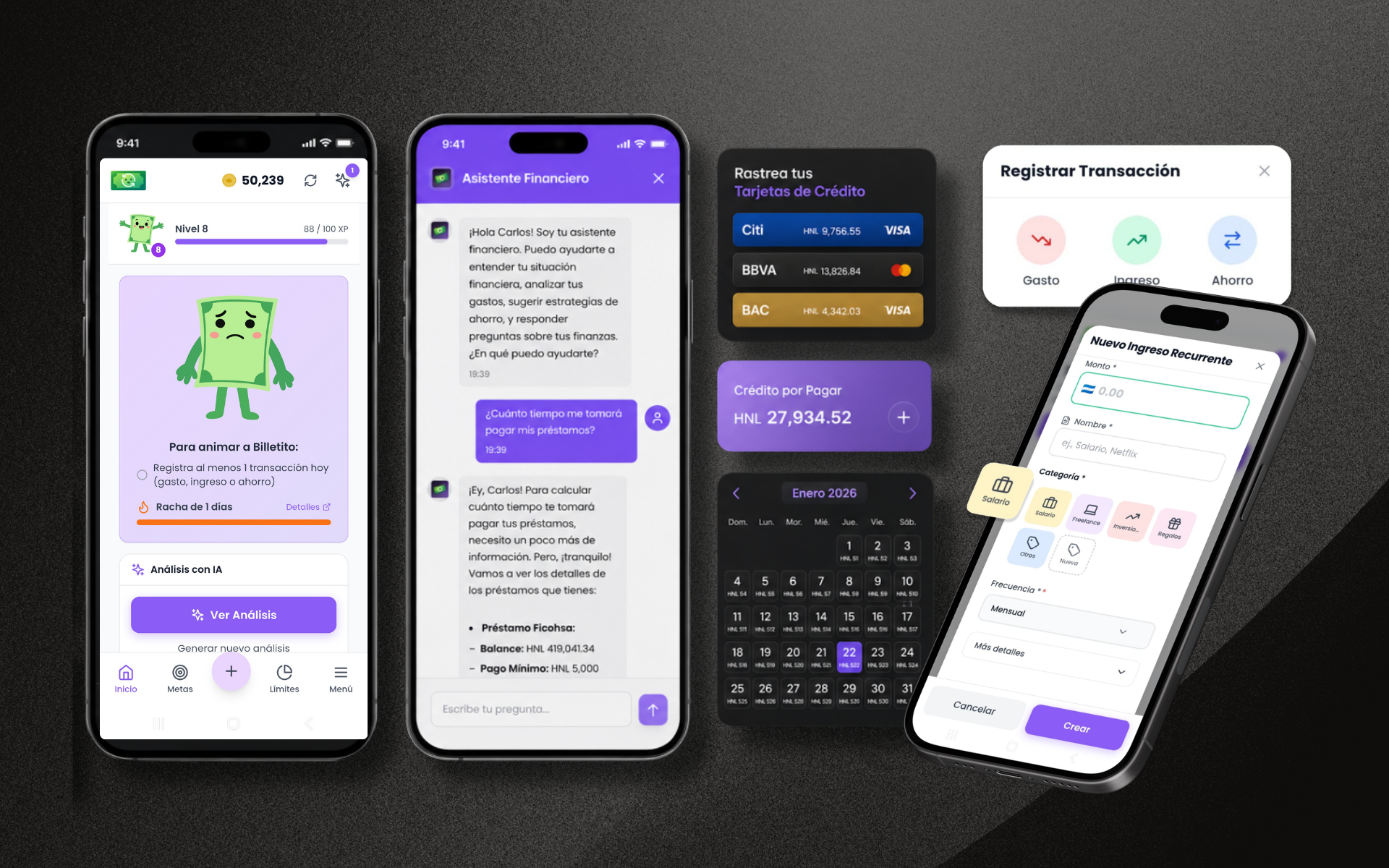
The Problem
Existing personal finance apps show you data ("you overspent on food last month") but never explain the behavior behind it or tell you what to actually change. The insight stops at the chart. Generic budgeting advice does not account for how you specifically spend.
The Solution
Built a personal finance Android app, available on Google Play, that uses your own transaction history as context. An AI layer answers questions about your finances, identifies the behavioral patterns driving overspending, and gives personalized, actionable tips. Built entirely from a personal need.
The Foundation
Quality Engineering
Quality engineering is where I learned to think systematically. I spent years working with Product and Engineering teams to build testing workflows from scratch, define standards, and ship software with confidence.
That mindset follows me into everything I build: define what success looks like, test assumptions early, and reduce the failure surface before it reaches users.
Technologies & Tools
Let's Work Together
Let's build something
useful.
Whether you have a product idea, a workflow to automate, or a system to improve, I'd love to hear about it.